-(1900-x-600-px).png)
Peter's 70th anniversary reading challenge
If you would like to donate to Peter's fundraising page, you can find it at: https://www.justgiving.com/page/peter-newbridge-reading
Reviews
7: THE TRUTH ABOUT PRISONS: PRISONERS, PROFESSIONALS AND FAMILIES SPEAK OUT by Richard W Hardwick

I found, ‘The Truth About Prison’, to be an insightful and thought provoking read. Richard W Hardwick brings together the voices of prisoners, prison professionals, and family members to provide a balanced and human account of a wide range of issues of life affected by imprisonment.
What makes this book particularly valuable is its focus on real experiences rather than statistics, theory or an individual viewpoint. The personal stories help readers understand the challenges faced by people in custody, the pressures experienced by staff, and the emotional impact on families.
The book is structured around key areas of prison life with a number of people recording their experience of the issue. For example, debating the implementation and impact of prison courses includes a response from three men in prison serving long sentences, three probation officers, a Professor of Psychology and a Governor.
The book challenges common stereotypes about prisoners and encourages readers to think carefully about rehabilitation, and the role of society helping people rebuild their lives. It does not ignore the realities of crime and punishment, but it presents them within a broader context that is both informative and compassionate.
Hardwick’s writing is accessible and engaging. It serves as a reminder that every prisoner has a personal story and that meaningful change is often supported by the efforts of dedicated professionals, families, and volunteers.
Erwin James wrote this review: ‘Different to any other book on prison. Compelling and quite breath-taking in its scope of insights, giving a voice to the only people that really know.’
I would agree with Erwin’s words and encourage anybody involved in prison life to read this book and listen to the voices of all those who contributed to this thought provoking read.
6: 'AYYY GOV': SURVIVING THE PRISON SERVICE AS A BLACK FEMALE PRISON OFFICER by Samdra Camila

Sandra Camila starts her book with an introduction ‘My Why’. She shares her firsthand experiences living as a black child raised mainly by her Mother whilst her Father was in prison. Underpinning these early experiences is a strong Christian faith. She quotes, ‘pain births purpose,’ to illustrate her belief that God has a way of making that ugly thing or experience a beautiful testimony.
Sandra’s significant academic life at school and university informed and deepened her understanding of black socialisation and the criminal justice system and allowed her to put her own experiences into a wider context. It was these studies, along with her lived experiences, which guided her to take on the role of a prison officer. The role of a female black prison officer came with many challenges as she tried to be herself in a male dominated environment. Talking to the men in prison, being friendly but not a friend, smiling and listening to break down barriers to gain trust and a greater understanding of the men’s needs. Her aim was to be more initiative-taking to the men’s needs rather than just being reactive, as was the norm of the culture on the prison wing. Quiet conversation not shouting, listening and understanding not control of rules and procedures. These personal strategies resulted in meetings with security officers and governors who were concerned about her inability to adjust to the norm of prison wing culture.
Sandra Camila became stronger in her resolve to be herself, but a traumatic incident caused her such pain that she felt unable to continue in her role. This incident exemplified her ongoing concerns regarding the treatment of women, particularly black women.
Her opening introduction and quote ‘pain births purpose’ is revisited at the end of her memoir, stating that without the pain and trauma during her time as an officer she would not have authored this book.
5: THE PRISON DOCTOR: WOMEN INSIDE by Dr Amanda Brown
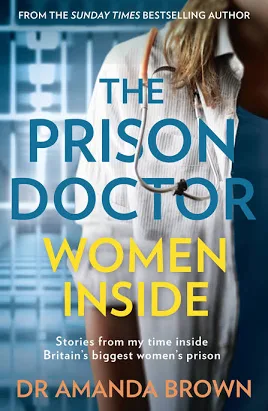
Dr Amanda Brown left general practice and started work in the prison service and finally in HMP Bronzefield. This prison is the largest female prison in Europe and the only purpose-built prison solely for women and only one of two prisons in the UK to house category ‘A’ prisoners. The book is a series of individual stories of women of all ages and backgrounds. It includes those serving long sentences, young women caught in cycles of addiction, and even older women who have spent much of their lives inside. These personal narratives offer insight into why people end up in prison, including domestic abuse, socioeconomic hardship, and substance abuse disorders.
The writing in the book is straightforward and accessible and is aimed at the general reader, not an academic audience. The stories are powerful but are often limited to Dr Brown’s conversations with patients in her surgery and lack an analysis of the overall impact of the women’s time in HMP Bronzefield. However, Dr Brown acknowledges the variety of social events, and training courses available to enable future work for those who choose to participate. She highlights the impact of drug use as the key cause of many of the women’s crimes and subsequent time in prison. But also identifies the difficulty of many women who receive endless short sentences and consequently not the long-term support to address addiction and mental health issues. She questions the place of prisons for women with these challenges and the many who are released into homelessness.
Instead of cold statistics, you meet women whose lives are shaped by forces – poverty, homelessness, abuse, addiction, and mental health. It strikes a balance between social commentary, personal testimony, and medical real-life storytelling. It’s a compassionate lens on the failings and possibilities of care inside prisons for some very vulnerable women.
4: A BIT OF A STRETCH by Chris Atkins
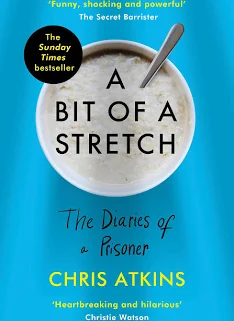
Chris Atkins, a documentary filmmaker, is sentenced to five years for tax fraud. He enters prison not as a hardened criminal, but as somebody ‘ordinary’ – middle-class, educated, and completely unprepared for what he is about to experience. He does not write to glorify crime or dramatize prison life. Instead, he writes a very readable, detailed diary of his time in HMP Wandsworth. The diary is full of detailed observations that manage to be funny, human, and quietly devastating.
He simply describes what he sees, hears, and experiences - underfunded facilities, overworked staff, inconsistent discipline, and people in prison treated as problems to be managed rather than people to be rebuilt. He shows how prisons can increase criminality because the system strips away confidence, stability, employability, and connection to the outside world. He describes people in prison struggling with mental illness, addiction, learning difficulties, trauma, and poverty – people who are not monsters but damaged, neglected, and often failed long before they ever committed a crime. He does not excuse criminal behaviour or pretend everyone is misunderstood but he does force the reader to confront the truth: prison often warehouses society’s most vulnerable people instead of helping them.
‘A Bit of a Stretch’ is very readable book, funny, disturbing, compassionate and infuriating in equal measure. The people feel real, and small details carry enormous weight. The book serves as an indictment of a prison system that seems less interested in justice than in containment.
3: BEHIND BARS by Charles Bronson
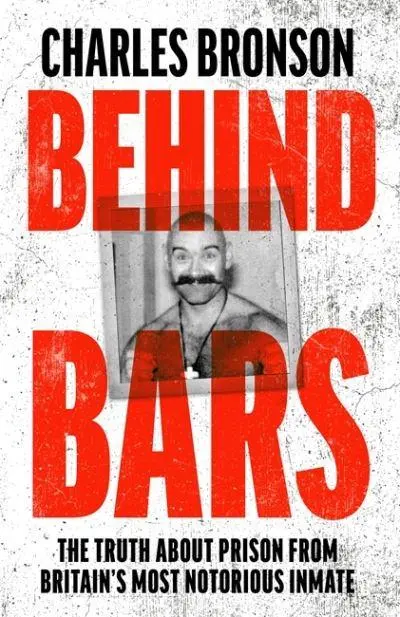
Charles Bronson’s book focuses mostly on the life inside of one man who has over 40 years of experience in prisons and high-security units. He records many quotes in the last section of the book that reflect his own position. This is one quote that in many ways sum-up one of his key messages.
‘The vilest deeds like poison weeds
Bloom well in prison air;
It is only what is good in man.
That wastes and withers there.’ Oscar Wilde
The book is a series of sections that record Bronson’s experiences throughout his long sentence and his interest in the history of the penal system. These sections include an A-Z of prisons, hostage taking, professional reports from legal and medical officers and his criminal history. Throughout these sections he focusses on the many prison regimes he has experienced and how he reacted to boredom and monotony through often violent exchanges between himself and officers. He doesn’t glamorise violence but explains its place in the culture of prison. Most of his 40 years were spent in segregation or isolation cells spending 23 hours of every day with locked doors. He explores how isolation and routine can warp perception leading to conflict, survival instincts, vulnerability, and lack of control. The book can help volunteers appreciate that many behaviours which look ‘difficult’ to outsiders often have roots in the institutional realities of confinement.
One of the greatest strengths of ‘Behind Bars,’ is its ability to humanise someone who, to many readers, is a symbol of danger. The fact that, like many people in prison, he wants meaning, dignity, and connection, even in the harshest of conditions. For volunteers, this is critical. It reminds us that behind every inmate label is a complex person with a story, not just a statistic or risk profile. It challenges readers to look beyond headlines to the human realities of incarceration.
April 2026
2: THE LIFE INSIDE by Andy West
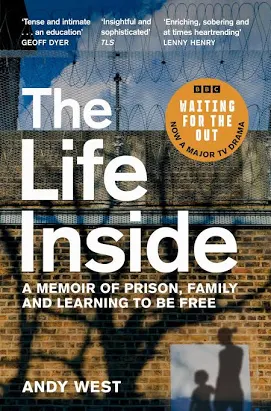
Andy West starts each chapter with a quotation. This quote is the first and captures one of the main themes of the book.
‘Justice: to be ever ready to admit that another person
is something quite different from what we read when
he is there.’ Simone Weil
‘The Life Inside’ is a deeply humane memoir that gives an insider perspective on the realities of prison life – not from the viewpoint of policy makers, but from someone who has spent years teaching philosophy inside various prisons. The project, which included men and women, discussed what it means to live, think, suffer, and hope within a system built around punishment. He also grew up with a Father, an Uncle and a brother who were all imprisoned, a legacy that left him carrying guilt, fear and questions about identity and fate long into adulthood. The book is structured around philosophical themes – freedom, shame, identity, forgiveness, time – each chapter weaving together classroom conversations with moments from his own life.
His students in prison are not portrayed as stereotypes, but as complex, witty, thoughtful individuals. The book overturns the flat ‘victim v villain’ myth and replaces it with a rich mosaic of real people grappling with life behind bars. Their discussions – sometimes funny, sometimes deeply unsettling – reveal how conversations can be forms of freedom. West’s own struggle with shame and inherited guilt parallels many prisoners’ battles with identity and self-worth.
‘The Life Inside’ is more than a memoir, it’s a bridge between worlds often separated by stigma and silence. For volunteers of prison charities, this book offers not only a better understanding of prison life, but a reminder of the shared humanity at the heart of the toughest circumstances. It encourages readers to see people in prison not as stereotypes, but as whole people.
April 2026
1: MY NAME IS WHY by Lemn Sissay
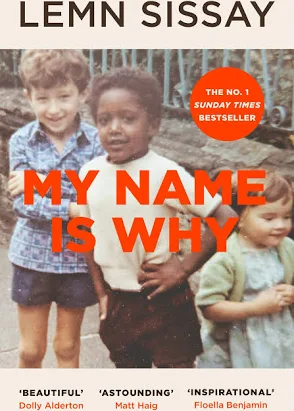
Lemn Sissay’s My Name Is Why is a powerful, deeply moving memoir that combines unflinching look at what it means to grow up without stability, belonging, or truth. It is not simply the story of one man’s childhood, but a wider indictment of a system that failed countless children in care.
The memoir is structured around his early life in foster homes and institutions, but what gives it such emotional force is the presence of one question: why? Why was he taken from his mother? Why was he lied to about who he was? Why did the adults around him seem so ready to discard him?
The most heartbreaking element of the book is the sense of deliberate erasure. Sissay describes being stripped not only of family, but of identity itself—his name, his origins, his history. The cruelty is not always loud; often it is bureaucratic, hidden behind paperwork and “procedure,” which makes it even more disturbing. The memoir reveals how devastating it can be when a child is treated like a case file rather than a human being. This is clearly evidenced by the continual use of reports of his time in care from social workers, psychologists, foster parents and other professionals who have taken decisions about Lemn’s life.
Ultimately, this is a memoir that stays with you. It is beautifully written, socially important, and emotionally devastating without ever feeling manipulative. My Name Is Why is essential reading—not just because it tells Lemn Sissay’s story, but because it forces the reader to confront the lasting impact of neglect, racism, and institutional cruelty. It is a book about identity, loss, and the human need to be known.
Lemn did not enter the adult prison system but the story of his life from birth to 18 years old reflects many of the key factors faced by too many people from the care system who are now held in prison.
April 2026
About this blog...
My name is Peter, and I have been volunteering with the New Bridge Foundation for over 17 years. Our charity was established 70 years ago by Lord Longford to support prisoners who are isolated from the wider society. The work of volunteers provides a bridge to the outside world, along with an increased sense of value and potential for their future. This long-term support is through regular written correspondence and visits together with support on release for those who ask for continued support. I am proud to say that several of my previous befriendees have gone onto establish meaningful crime free lives.
To support New Bridge and to celebrate our 70th anniversary many of the volunteers are completing various challenges. Sadly, I cannot run a marathon or swim many kilometres, so I have chosen to read a book related to prisons and prisoners for every decade of the charity and write a review for each book. It is hoped that the reviews will support new volunteers to widen their understanding of prisons from a wider perspective and generate some funds to enable our valuable work to continue.
This page will be updated with a new review each time I finish one of the 7 books.
If you would like to donate to my fundraising page, you can find it at: https://www.justgiving.com/page/peter-newbridge-reading